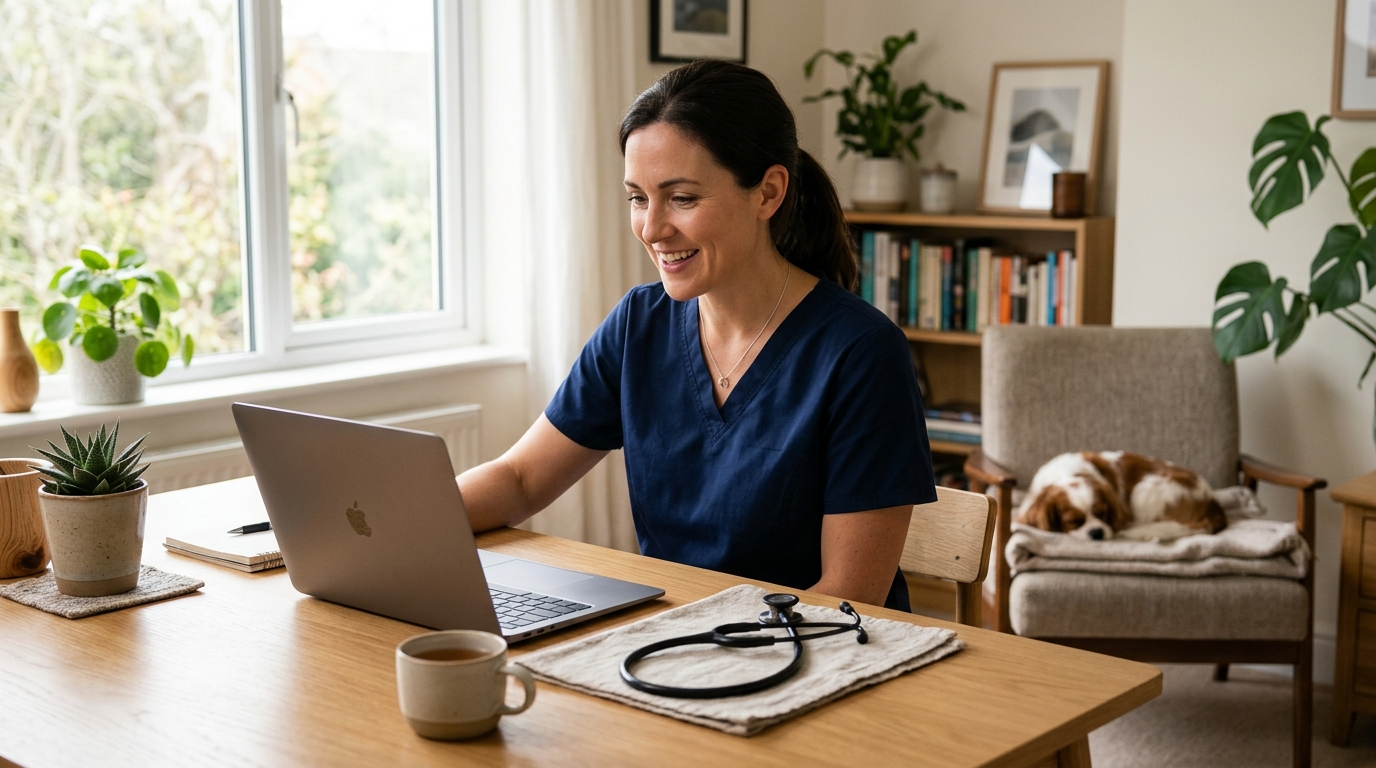
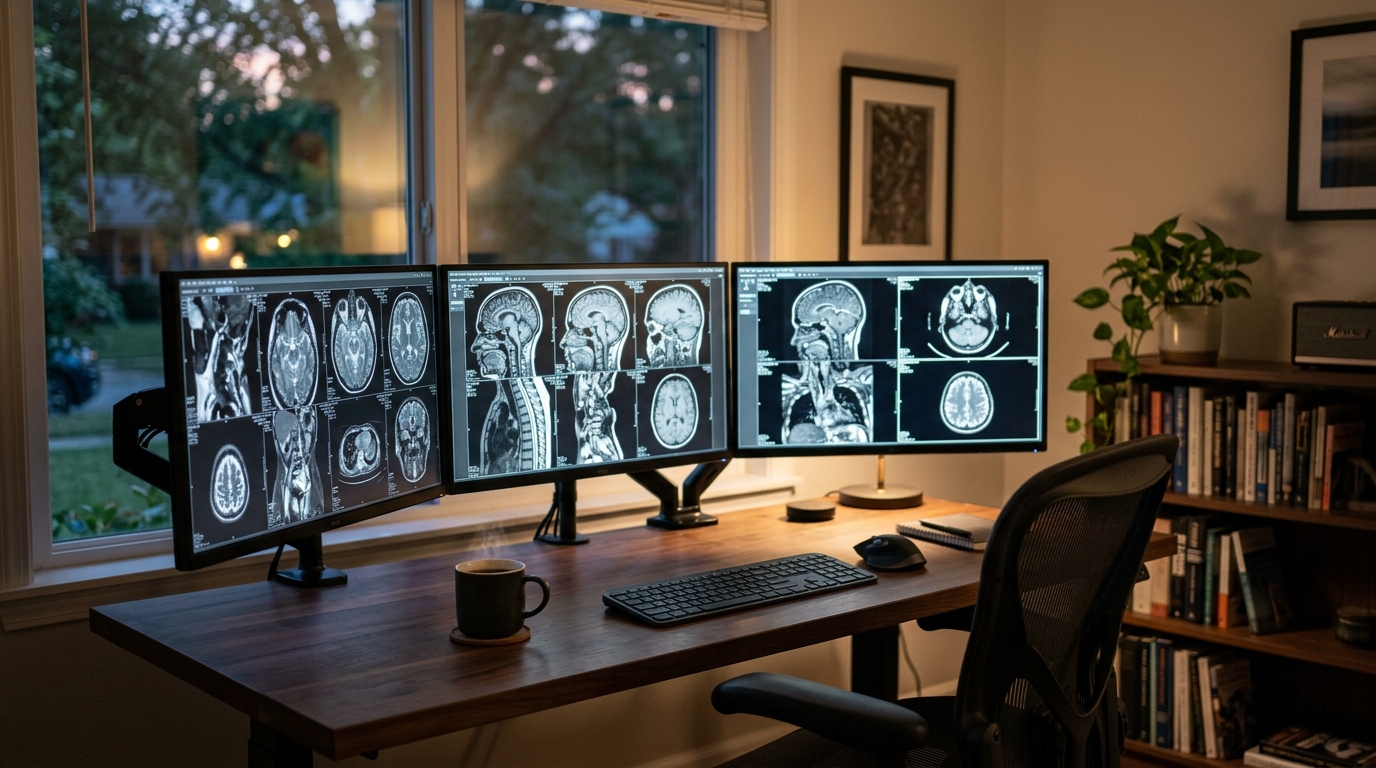
Radiology is one of the only medical specialties where a meaningful share of the job market no longer requires showing up to a hospital basement. That's teleradiology — and if you're a resident, fellow, or practicing radiologist weighing a move into it, the honest version of "how to become one" isn't a certification you can knock out in a weekend course. It's the same residency and board-certification path every radiologist walks, plus a state-licensing maze that most explainers skip entirely, plus a very real tradeoff in call volume and solo reading that's worth knowing about before you sign a contract.
Here's what the path actually involves, what it pays, and who's hiring.
What a Teleradiologist Actually Does
A teleradiologist interprets diagnostic imaging — X-rays, CT, MRI, ultrasound, PET — for a hospital, imaging center, or group they aren't physically inside, reading from a home office or a teleradiology company's remote hub instead. The images arrive over a secure PACS (picture archiving and communication system) connection; the radiologist dictates a report that goes back to the ordering facility, sometimes as a final read (the official diagnostic report) and sometimes as a preliminary read that an on-site radiologist signs off on later.
Most teleradiology work still skews toward covering gaps other radiologists don't want: nights, weekends, and overflow volume during the day. That's shifting as more groups build fully remote day shifts, but the "cover the hours nobody wants" origin of the field still shapes a lot of how it's staffed and paid.
The Education and Certification Path
There's no shortcut version of this. A teleradiologist is a fully trained radiologist — the steps are identical to becoming any other kind of radiologist:
- MD or DO degree.
- A clinical internship year accredited by the ACGME (or RCPSC in Canada) — this has to happen before diagnostic radiology residency and can't be completed outside the US or Canada.
- A four-year ACGME-accredited Diagnostic Radiology (DR) residency.
- The American Board of Radiology (ABR) Qualifying/Core Exam, taken after at least 36 months of training.
- The ABR Certifying Exam, which you can't sit for until at least 12 months after finishing residency.
- Optional subspecialty fellowship + Certificate of Added Qualification (CAQ) — a year of ACGME-accredited fellowship training (neuroradiology, musculoskeletal, body imaging, and so on) plus a year of clinical practice in the subspecialty. This step matters more for teleradiology than it does for a typical hospital job: several of the highest-paying remote postings specifically want fellowship-trained subspecialists, not generalists.
Osteopathic radiologists can certify through the American Osteopathic Board of Radiology (AOBR) instead; most teleradiology employers accept either.
The Part Competitors Skip: State Licensing
This is the piece that trips people up, and it's also the piece the current top-ranking pages for this search (a career-FAQ site, a generic careers aggregator, and a vendor blog post) barely touch. The American College of Radiology's policy is that a physician interpreting images remotely needs an active medical license in both the state where the image was generated and the state where the physician is physically sitting when they read it.
Requirements vary a lot by state:
| License requirement | States |
|---|---|
| No license needed for this specific purpose | Delaware, Hawaii, Idaho, Rhode Island, Wyoming |
| Partial/limited requirement | Kentucky, Louisiana, Maryland |
| Telemedicine/teleradiology-specific license only | Minnesota, Montana, New Mexico, Ohio, Oregon, Tennessee, Texas |
| Full medical board license required | The remaining ~35 states |
The Interstate Medical Licensure Compact speeds up getting licensed in multiple compact states, but it doesn't cover everywhere — Texas, California, New York, and Florida are all outside it, which matters a lot if your client base skews toward those four. In practice, this is why a lot of teleradiology job postings specifically advertise "start with one license" as a selling point: the employer is handling (and usually paying for) the rest of the licensing buildout over your first several months, rather than requiring you to arrive already licensed everywhere they read for.
What Teleradiologists Actually Get Paid
The Bureau of Labor Statistics doesn't break teleradiology out as its own line item, but its radiologist wage data (SOC 29-1224, May 2025) is the closest official benchmark: a median annual wage of $420,860, ranging from $89,010 at the 10th percentile to $594,410 at the 90th.
Named teleradiology employers advertise meaningfully higher ranges for experienced, often subspecialty-trained radiologists:
| Employer | Arrangement | Advertised pay range |
|---|---|---|
| Radiology Partners / Matrix | Part-time or full-time, W-2, starts with one state license | $350,000–$600,000 (part-time); $500,000–$550,000 (full-time) |
| vRad (Virtual Radiologic) | Full-time W-2, fellowship-trained subspecialists | $450,000–$900,000 |
| Teleradiology Solutions | 100% remote, final and preliminary reads | $500,000–$950,000 |
Pay is typically productivity-based (per-study or per-wRVU rather than a flat salary), which is also why the ranges are so wide — a radiologist taking every available overnight and weekend shift is going to land at the top of these ranges, and one working a lighter part-time schedule will land toward the bottom.
Who's Hiring
A few names show up repeatedly once you start looking past generic job-board listings:
- vRad — one of the largest dedicated teleradiology groups, hiring fellowship-trained subspecialists (neuroradiology, emergency radiology) into full-time W-2 roles with no call requirement.
- Radiology Partners' Matrix division — the internal teleradiology arm of one of the largest radiology practices in the country; flexible part-time and full-time schedules, 24/7 US-based IT and call-center support, and a lower licensing bar to get started.
- Teleradiology Solutions — founded in 2002, Best in KLAS-rated, Joint Commission-accredited since 2005, with radiologists licensed across 20+ states reading for 120+ US client facilities.
- ACR Career Center — the American College of Radiology's own job board, and the one place in this space that now requires every employer to disclose salary ranges on a posting, which makes it worth checking even if you ultimately apply directly through an employer's own site.
The Tradeoffs Nobody Puts in the Job Posting
The posted pay ranges are real, but so is the workload behind them. Radiologist burnout isn't a teleradiology-specific problem, but it's a documented one across the specialty: a global survey of radiologists found 53% cite burnout as their top professional concern, 88% have worked night shifts at some point in their careers, and 47% say night-shift work reduces their own diagnostic accuracy.
Teleradiology adds a specific version of that pressure: reading solo and at volume, often without a colleague down the hall to sanity-check a tough case or immediate access to the patient's full chart, pathology, or surgical history the way an on-site radiologist would have. That's a big part of why most teleradiology groups want candidates with real on-site reading experience first, rather than hiring straight out of residency — the job rewards radiologists who've already built the pattern-recognition speed and the judgment to know when a case genuinely needs a second opinion, since the infrastructure for getting one quickly is thinner than it is in a hospital reading room.
Is Teleradiology Right for You?
If you're fellowship-trained (or close to it), comfortable reading at volume without a colleague in the next room, and want real control over your schedule and location, teleradiology is one of the more financially rewarding ways to practice radiology remotely — the names above are actively hiring, and the pay reflects genuine demand for licensed, board-certified radiologists willing to cover the hours and case volume that keep emergency departments and imaging centers running.
If you're earlier in training or haven't built up solo-reading experience yet, it's worth banking a few years in a traditional on-site or hybrid role first — the licensing and credentialing requirements aren't going anywhere, and neither is the demand.
Either way, JobSnag's teleradiology jobs hub tracks current openings from groups like these, and the broader remote healthcare jobs category covers adjacent remote clinical roles if you're casting a wider net.
Line Cook — Houston, TX
Frequently asked questions
Do you need a radiology residency to become a teleradiologist?
Yes. Teleradiologists are fully trained, board-certified or board-eligible radiologists — there's no separate, shorter credential. You still need an MD or DO, a clinical internship year, and a four-year ACGME-accredited diagnostic radiology residency before you can sit for board certification.
How many states do you need a medical license in to work as a teleradiologist?
It depends entirely on which hospitals and imaging centers you read for. ACR policy requires you to be licensed in both the state where the image was taken and the state where you're physically sitting when you interpret it, so a teleradiologist reading for clients in 10 states generally needs licenses in all 10 (or close to it), though a handful of states (Delaware, Hawaii, Idaho, Rhode Island, and Wyoming) don't require one at all for this specific purpose.
How much do teleradiologists get paid?
The Bureau of Labor Statistics puts the broader radiologist occupation's median annual wage at $420,860 as of May 2025. Named teleradiology employers advertise meaningfully higher ranges for experienced, subspecialty-trained reads — Radiology Partners lists $500,000–$550,000 for full-time roles, vRad advertises $450,000–$900,000 for fellowship-trained neuroradiologists, and Teleradiology Solutions cites a $500,000–$950,000 range.
Can a radiologist go straight from residency into teleradiology?
Technically yes, but most teleradiology groups prefer candidates with a few years of on-site reading experience first. Reading solo, at volume, without a colleague down the hall to consult on a tough case is a different skill than reading inside a residency program's safety net, and most employers' postings reflect that preference.
What's the difference between teleradiology and a regular remote radiology job?
In practice, not much — "teleradiology" usually just describes the arrangement (reading images for a facility you're not physically inside), while a "remote radiology job" is the same thing from a job-posting title. The real distinctions that matter are whether the role is W-2 or 1099, final-read or preliminary-read only, and how many states' licenses it requires.