
One December morning in 2017, Rick Marvin was tossing lobster traps off the side of a boat off Cape Cod when his boot caught in the rope of a trap he'd just thrown overboard. The trap was already sinking, and it took him with it.
"Before I knew it, I was dragged off the boat, and all I saw was water," Marvin told the Provincetown Independent. There was no time to cut the line. Several feet underwater, he made one last desperate kick, knocked the boot loose, and clawed back to the surface, where his crew hauled him in.
He lived. Many don't. And his close call is a useful reminder of something the headlines about "dangerous jobs" tend to flatten: behind every fatality rate is a routine task — throwing a trap, trimming a branch, stepping onto a roof — that went wrong in seconds.
So which jobs are actually the most dangerous in America? Not the scariest-sounding ones, but the ones where workers are statistically most likely to die. The clearest answer comes from the U.S. Bureau of Labor Statistics, which counts every fatal work injury in the country each year.
How we ranked them
There are two ways to measure a deadly job, and they tell different stories.
The first is the raw body count. By that measure, truck drivers and construction workers look the most dangerous, simply because millions of people do those jobs. The second — and fairer — measure is the fatal injury rate: deaths per 100,000 full-time-equivalent workers. That rate levels the playing field, so a tiny, lethal trade like logging isn't hidden behind a profession with a huge workforce.
This ranking uses the rate, drawn from the BLS Census of Fatal Occupational Injuries (CFOI) for 2024, the most recent data available. For context, the national average is just 3.3 deaths per 100,000 workers. Every job on this list is many times deadlier than that.
A note before the list: 2024 was, relatively speaking, a safer year. There were 5,070 fatal work injuries, down 4% from 5,283 in 2023, and the overall rate fell for the second year running. Still, a worker died on the job roughly every 104 minutes.
Key takeaways
- Logging is the deadliest job in America, with a fatal injury rate around 30 times the national average.
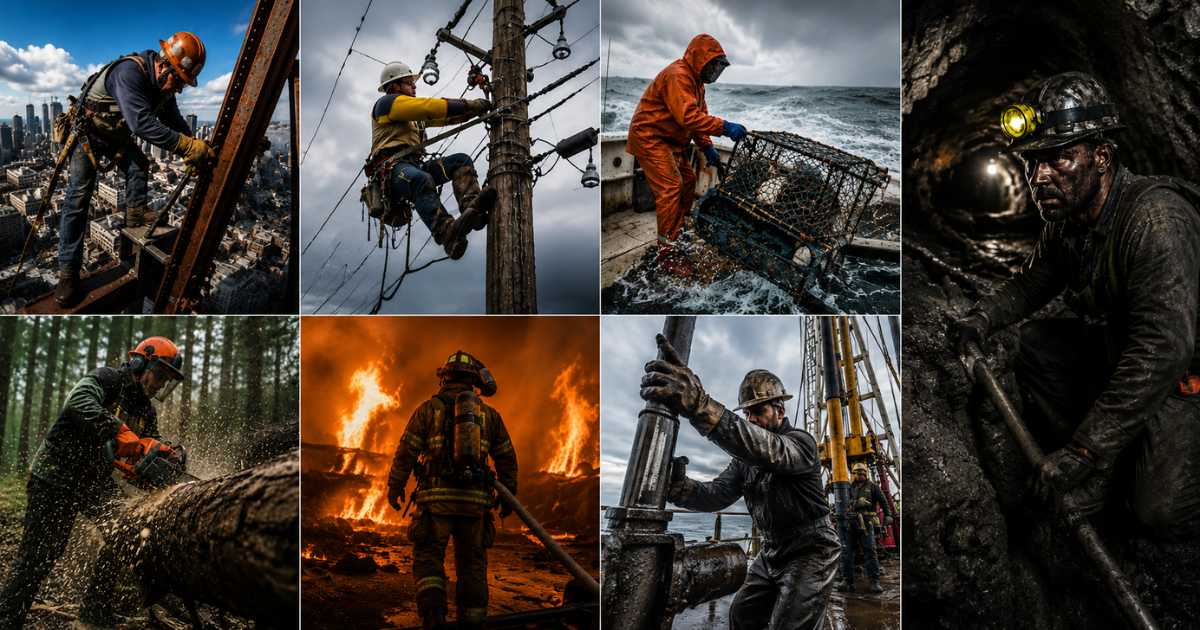
- The deadliest work clusters in three places: the woods, the water and high off the ground.
- Transportation incidents are the single most common way workers die — 38% of all on-the-job deaths in 2024.
- High risk doesn't mean low pay. Several of these trades pay well and are hiring.
The 10 most dangerous jobs in America
1. Logging workers — 98.9 deaths per 100,000
Logging has topped this list for years, and it isn't close. With a fatal injury rate near 99 per 100,000, it runs roughly 30 times deadlier than the average American job, according to the University of Washington's Pacific Northwest Agricultural Safety and Health Center.
Why so lethal? It's the combination — chainsaws and spinning blades, multi-ton logs, steep and slick terrain, remote sites hours from a hospital, and gravity. Loggers even have a name for the branches that kill them: "widowmakers," dead limbs hung up in the canopy that drop without warning. Most logging deaths come from being struck by falling trees and limbs.
It's grueling, but not joyless. Recent NIOSH-supported interviews found surprisingly high job satisfaction among loggers, and the trade often pays better than other rural work.
2. Fishing and hunting workers — 86.9 deaths per 100,000
Commercial fishing is dangerous for a simple reason: when something goes wrong on the water, help is far away. As one safety navigator who works with Cape Cod fishermen put it, "You don't have quick access to emergency care when you're in a vessel. The Coast Guard isn't right down the street like the ambulance is."
Most deaths come from falls overboard and vessels sinking in heavy weather. The grimmest detail: the CDC reports that in a large share of overboard drownings, the worker wasn't wearing a flotation device — and was often alone, with no one to see them fall.
There's also a culture problem that crews are slowly fixing. "You'd be surprised at the number of fishermen who don't know how to swim," the same navigator said. "They say, 'I work in the water. I don't go in the water.'"
3. Roofers — 51.8 deaths per 100,000
After the woods and the water comes height. Roofing is the deadliest of the construction trades, and the math is brutally simple: people who work all day near an edge, on a slope, in the heat, eventually fall. Falls, slips and trips killed 844 workers across all jobs in 2024, and roofers are squarely in that danger zone.
4. Refuse and recyclable material collectors — 41.4 deaths per 100,000
Garbage and recycling collection rarely makes "dangerous jobs" lists in the public imagination, but it should. The hazard isn't the trash — it's the traffic. Workers spend their shifts stepping in and out of the road beside a heavy truck, often in the dark, exposed to distracted drivers and the truck's own machinery.
5. Aircraft pilots and flight engineers — 31.3 deaths per 100,000
This rate is driven less by major airlines than by the riskier corners of aviation: crop dusting, bush flying, helicopter tours, medical transport and flight instruction. When something fails in the air, the margin for error is unforgiving.
6. Construction trades — 27.4 deaths per 100,000
Construction is the deadliest job in America by sheer numbers: 1,032 workers died in 2024, more than any other single field. Falls lead the causes, followed by being struck by objects and equipment and electrocutions — the grim "Fatal Four" that OSHA has tracked for years.
7. Delivery drivers and truck drivers — 26.8 deaths per 100,000
Driving for a living is so common that it's easy to forget how dangerous it is. Transportation incidents are the leading cause of work deaths in America, accounting for more than a third of the total. Truck drivers alone made up roughly a fifth of all workplace fatalities in 2024.
8. Grounds maintenance workers — 20.5 deaths per 100,000
Landscapers, groundskeepers and tree-care workers face a mix of hazards that adds up fast: heavy mowers and chippers, falls from height while trimming trees, electrocution near power lines, and roadside work next to passing cars.
9. Farmers, ranchers and agricultural workers — 20.2 deaths per 100,000
Agriculture's biggest killer is the equipment, especially tractor rollovers, along with grain-bin entrapment and livestock. Farms are also family workplaces, often far from emergency care, which raises the stakes on every accident.
10. Structural iron and steel workers — 19.8 deaths per 100,000
The people who raise the steel skeletons of buildings and bridges work at extreme heights, guiding multi-ton beams into place. Falls are the dominant risk — which is why you'll see ironworkers tied off to anything solid.
What actually kills workers
Look across the whole list and a few patterns repeat.
Transportation is the big one — 38.2% of all work deaths in 2024 involved a vehicle, on a road or off it. Falls come next, and they're concentrated in the trades that work up high. Then there's being struck by an object — a tree, a beam, a truck — and a smaller but real category of workplace violence.
In other words, the deadliest jobs aren't deadly because the work is exotic. They're deadly because of physics: heavy things, high places and fast-moving vehicles, repeated thousands of times until the odds catch up.
Dangerous doesn't mean badly paid
Here's the part that often gets lost. Many of these high-risk jobs are also stable, in-demand and reasonably well-paid. Logging and the skilled trades frequently pay more than other work available without a four-year degree. Truck driving remains one of the largest occupations in the country. And demand isn't going anywhere — someone has to build the buildings, keep the power on and bring in the catch.
The difference between a dangerous job and a deadly one often comes down to training, equipment and culture. The Cape Cod fishermen are a small but telling example: after local safety trainings began, more crews started wearing flotation devices and practicing what to do when a boat floods. One lobsterman who'd survived a leak before and after the training described the change plainly — the first time, "I remember panicking"; the second time, he stayed calm and fixed the problem.
If you work in one of these fields, or you're considering one, that's the real takeaway. The risk is real, but it's not random. Respect the hazard, insist on the training and gear, and never assume the routine task is the safe one — that's what the data, and the people who've lived it, keep telling us.
You can browse current openings across the U.S. on JobSnag, including roles in the trades, transportation and skilled fields where safety-minded employers are hiring now.
Sources: U.S. Bureau of Labor Statistics, Census of Fatal Occupational Injuries Summary, 2024; CDC/NIOSH Commercial Fishing Safety; University of Washington PNASH, "Behind the injury numbers — Listening to loggers"; worker accounts via The Provincetown Independent, "Fishing Is Still the Most Dangerous Job."
Line Cook — Houston, TX
Frequently asked questions
What is the most dangerous job in America?
Logging, with a fatal injury rate of about 98.9 deaths per 100,000 workers — roughly 30 times the national average of 3.3.
Which job has the most worker deaths overall?
Construction, with 1,032 worker deaths in 2024 — more than any other single field — though its rate per worker is lower than logging or commercial fishing.
What causes the most workplace deaths in the US?
Transportation incidents, which accounted for 38% of all on-the-job deaths in 2024, followed by falls and being struck by an object.
Do dangerous jobs pay well?
Often, yes. Many high-risk trades such as logging, the skilled construction trades and truck driving pay more than other work available without a four-year degree, and demand for them is steady.