
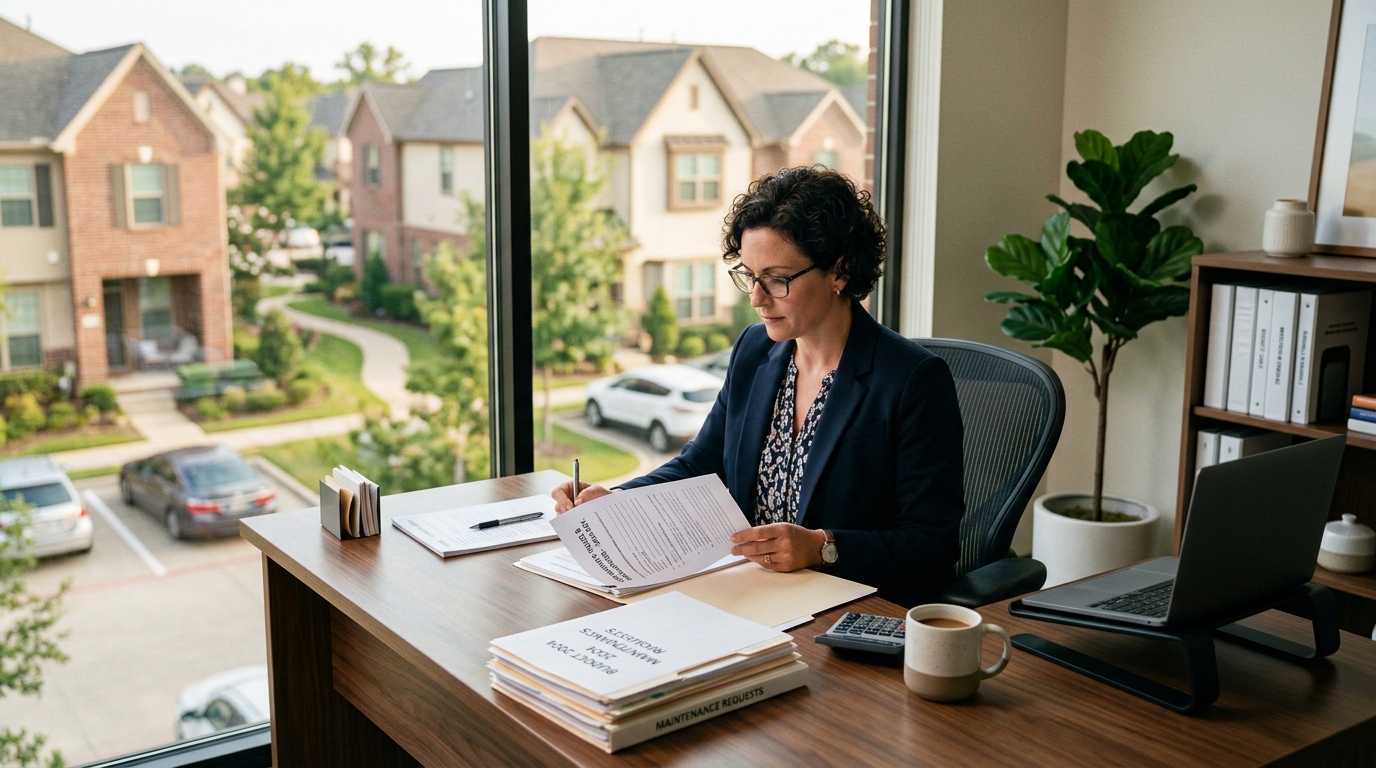
Nearly a third of US homeowners live inside a community association — an HOA, a condo board, or a co-op. Almost none of them could tell you who actually runs it, until a pipe bursts, an assessment doubles, or a board meeting turns into a shouting match. That person is a community association manager, and the path into the job looks nothing like the vague "property management" job titles that dominate the search results for it.
Here's what the role actually pays, whether you need a license, and what people doing the job right now say about it.
What does a community association manager actually do?
A community association manager is the paid professional who runs the day-to-day business of a homeowners association, condo building, or co-op on behalf of its volunteer board. The job swings between finance, maintenance, and conflict resolution, often within the same afternoon: reviewing a reserve study in the morning, then mediating a dispute between two neighbors over a parking spot by lunch, according to PropertyManagementJobs.us.
The core responsibilities are fairly consistent across employers:
- Preparing and tracking the association's annual budget and reserve funds
- Collecting assessments and following up on delinquent accounts
- Hiring and managing vendors (landscaping, maintenance, security)
- Enforcing community rules and covenants
- Planning and running board meetings, which are typically held in the evening
- Keeping the association compliant with state and local housing law
Larger management companies also hire assistant community managers — an entry point that doesn't require certification or experience managing a full portfolio on your own. If you're looking at listings right now, JobSnag's Community Management jobs page tracks current openings at this level and above.
How much do community association managers make?
The Bureau of Labor Statistics groups this role under "Property, Real Estate, and Community Association Managers." The most recent data puts the national median at $69,990 a year — but the range is wide, because pay depends heavily on portfolio size and property type.
| Pay percentile | Annual wage |
|---|---|
| Lowest 10% | Under $41,010 |
| Median | $69,990 |
| Highest 10% | Over $139,680 |
Source: BLS Occupational Outlook Handbook
That top end tends to belong to managers running large-scale or luxury portfolios rather than a single suburban HOA. The Community Associations Institute's own 2023 member survey found pay for large-scale community managers climbed from roughly $140,000 to $155,000 in a single year, and 78% of surveyed managers rated business prospects for the field as "good" or "very good," according to CAI's HOAResources salary data. The BLS also projects about 4% job growth through 2035 — roughly average — with about 36,900 openings a year nationally, mostly from people leaving or retiring out of the role.
Do you need a college degree?
No. The BLS lists a high school diploma or equivalent as the typical entry-level education for this occupation, with less than five years of related work experience expected going in.
Most people don't walk into a community manager title directly. The common path looks more like: leasing agent or property administrator → assistant community manager → community manager, picking up the CMCA certification somewhere along the way. A background in hospitality, retail management, or customer service transfers surprisingly well, since the day-to-day is as much about people management as it is about budgets.
The CMCA certification, step by step
The Certified Manager of Community Associations (CMCA) is the only national certification built specifically for this field, administered by the Community Association Managers International Certification Board (CAMICB) and accredited by the National Commission for Certifying Agencies.
To sit for the exam, you need one of the following:
- Completion of an approved CMCA prep course, or
- Two years of verified community-association management experience (available as a one-time waiver), or
- An active qualifying credential in Arizona, California, Florida, Illinois, or Nevada
The exam itself is 120 questions over 2.5 hours, covering governance, budgeting and reserves, risk and insurance, maintenance, HR, and ethics, per CAMICB's certification page and Pearson VUE's exam guide.
What it costs to get and keep:
| Step | Cost |
|---|---|
| Application + exam + first year | ~$360 |
| Retake (if needed) | $200 |
| Annual maintenance fee | $135/year |
| Recertification | Every 2 years, 16 continuing-education hours |
Source: CAMICB, cited via FirstService Residential
CAMICB and several industry sources report CMCA-certified managers earn roughly 20% more on average than managers without it — a meaningful incentive to get certified early rather than treating it as optional.
Does your state require a license?
For most of the country, no — community association management is unregulated, and CMCA certification is voluntary rather than a legal requirement. A handful of states are the exception:
| State | License required? | What it takes |
|---|---|---|
| Florida | Yes, above a size threshold | 16-hour pre-licensing course, 100-question state exam (75% to pass), background check with fingerprinting |
| Illinois | Yes | State-specific licensing under the Illinois Community Association Manager Licensing Act, with an approved prelicensure course |
| Nevada | State certification | Approved coursework, verified management experience, and a state exam |
| Most other states | No | Voluntary CMCA certification only |
Florida has by far the strictest rules, and they only kick in once an association is big enough to matter: a license is required if you're paid to manage an association with more than 10 units, or a budget of $100,000 or more, according to Florida's Department of Business and Professional Regulation. Florida licenses expire September 30 of every even-numbered year, and renewing one takes 17 hours of continuing education per two-year cycle.
If you're managing a small, self-run HOA in a state without licensing requirements, you can often start working — and get paid — before you're certified at all. Most employers will still expect you to pursue the CMCA within your first year or two.
What the job is actually like
Online reviews from people who've worked at HOA and community-management firms like Associa and Community Management Associates paint a fairly consistent picture: steady, varied work that rewards patience, with two recurring complaints — evening board meetings that run late, and portfolios that get stretched too thin.
Driving home at 11 p.m. after a board meeting is described as a normal part of the job, not an occasional exception, and homeowners who are "passionate" about their complaints are cited as the single biggest source of day-to-day stress. On the research side, PayScale's survey of working community association managers puts job satisfaction at 4.09 out of 5, which tracks with how the role is often described: not easy, but genuinely engaging for people who like variety over routine.
The honest failure mode is burnout from overload — managing too many communities with too little admin support, which leads experienced managers to switch employers rather than leave the field entirely, according to HOA Advisory Group's analysis of manager turnover. If you're coming from a high-churn service job, the structure of this role can feel like a relief; if you're expecting a quiet desk job, it won't be that either.
Is it worth it?
The numbers make a reasonable case: average pay above many entry-level office roles, a credential that pays for itself within a year if your employer values it, and a field with steady (if unspectacular) growth ahead. The job rewards people who are organized under pressure and comfortable being the one homeowners call when something goes wrong.
If the mix of finance, people management, and the occasional 9 p.m. board meeting sounds like your pace, the fastest way in is usually the simplest one: find an assistant community manager or leasing role at a management company near you, and start the CMCA coursework once you're in the door. JobSnag's full jobs board lists current openings across the field if you're ready to start looking.
Line Cook — Houston, TX
Frequently asked questions
Do I need a license to become a community association manager?
In most states, no. Community association management is unregulated outside of a few states, and the only credential most employers expect is the voluntary CMCA certification. Florida is the major exception: it requires a state-issued license once you manage an association with more than 10 units or a budget of $100,000 or more, which means a 16-hour pre-licensing course, a state exam, and a background check.
How much does the CMCA certification cost?
Getting certified through CAMICB runs about $360 total for the application, exam, and first year of certification. After that, it's $135 a year to maintain, plus 16 hours of continuing education every two years to renew.
Can I become a community association manager without a college degree?
Yes. The Bureau of Labor Statistics lists a high school diploma as the typical entry requirement for this field. Most people get in through leasing, front-desk property administration, or an assistant community manager role, then earn the CMCA once they're working the job.
How long does it take to become a community association manager?
There's no fixed timeline since there's no required degree. Many people move from an entry-level property or leasing role into an assistant community manager position within a year or two, then sit for the CMCA exam once they qualify, which can be as little as a few months after starting if you take an approved prep course instead of waiting out the two-year experience path.
Is Florida the only state that licenses community association managers?
No, though it has the strictest rules. Illinois and Nevada also regulate the role at the state level, with their own course and exam requirements. Most other states leave community association management unlicensed and rely on voluntary industry certification instead.