A phlebotomy certification can take as little as four to eight weeks. A nursing degree takes two to four years. Both jobs put you in scrubs, working hands-on with patients in a hospital, lab, or clinic — but only one of them you can realistically start this year without touching a college loan.
That gap is exactly why so many people search "how to become a phlebotomist" as a first step into healthcare. It's a real, in-demand job: the Bureau of Labor Statistics projects 6% employment growth for phlebotomists through 2034, faster than the average occupation, with roughly 18,400 openings a year nationwide. Here's what it actually takes to get there — the real certification costs, the states with their own licensing rules, and current pay data instead of a marketing school's optimistic estimate.
What Does a Phlebotomist Actually Do?
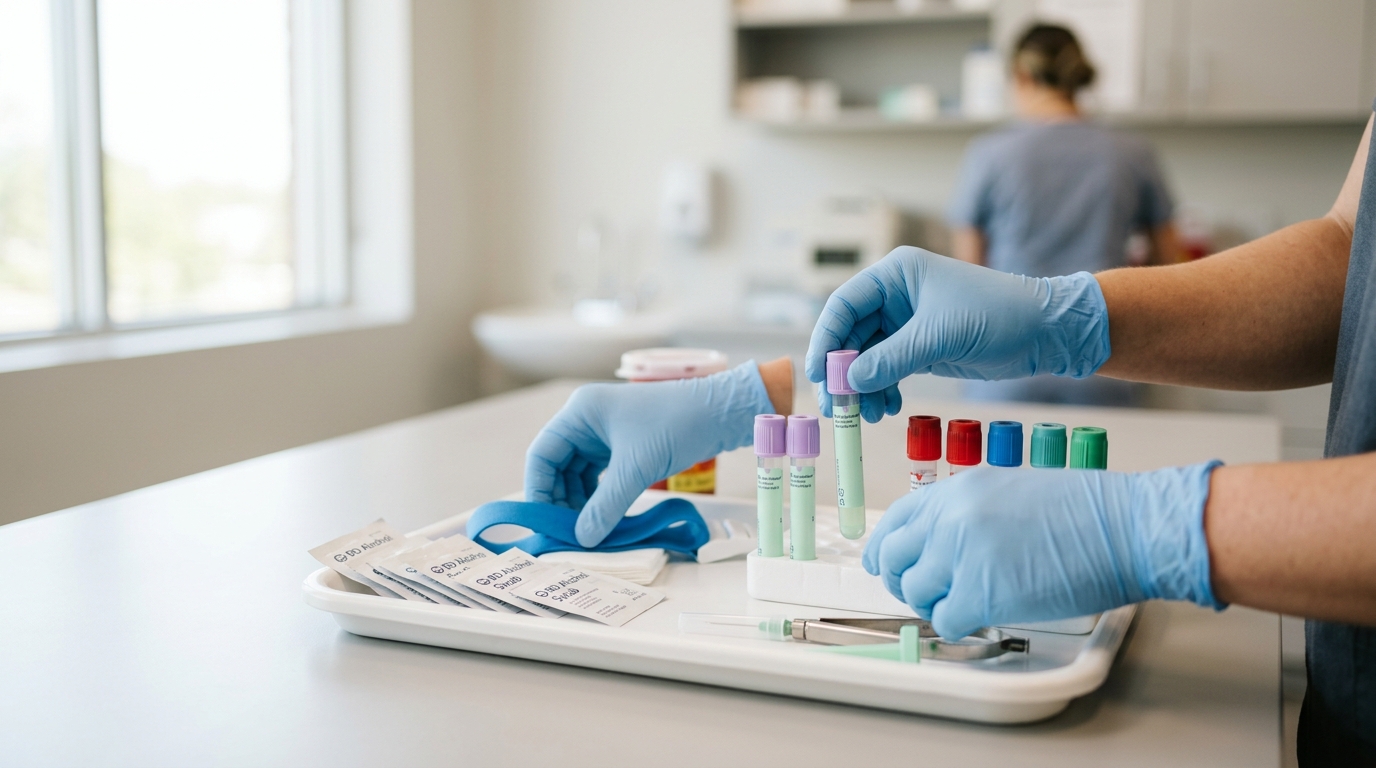
A phlebotomist draws blood for lab testing, transfusions, donations, and research — venipuncture and finger-sticks, mostly, plus labeling specimens correctly and keeping the chain of custody intact so results come back to the right patient. It's precise, repetitive, people-facing work, and it's the entry point into a huge swath of the healthcare system: hospitals, independent labs, blood banks, urgent care, and physician offices all hire for it directly.
That's also why it shows up so often on job boards. JobSnag's allied health jobs hub lists phlebotomist openings alongside EMTs, medical scribes, and sterile processing techs — the roles hospitals and labs are consistently short-staffed on, no four-year degree required.
How Long Does It Actually Take?
Here's the part vocational-school marketing pages tend to bury: most phlebotomy training programs run 4 to 12 weeks of classroom and clinical instruction, not months of general-education requirements. Community college certificate programs can stretch closer to a semester if they bundle in unrelated coursework, but a focused, hospital-affiliated program gets you into clinicals fast because the skill itself is narrow — you're learning venipuncture technique, specimen handling, and safety protocol, not a whole allied-health curriculum.
Most programs require you to complete a set number of successful live draws — commonly around 30 to 100 venipunctures and a smaller number of skin punctures — before you're eligible to sit for a national certification exam. That hands-on requirement is the real timeline driver, more than the classroom hours.
Certification Routes: ASCP vs. NHA vs. AMT
You don't need a license to train as a phlebotomist in most states, but you'll need a national certification to get hired almost anywhere serious, and several states require it by law (more on that below). Three organizations issue the credential most employers recognize:
| Certifying body | Credential | Exam fee | Renewal |
|---|---|---|---|
| ASCP | PBT (ASCP) | $155 | Every 3 years |
| NHA) | CPT (NHA) | $125–$250 | $185 every 2 years |
| AMT | RPT (AMT) | $125 | $75 per year |
Add training-program tuition, background checks, and a retake buffer, and the realistic all-in cost of getting certified lands somewhere between $700 and $3,200, depending on whether you go through a community college, a private vocational school, or an accelerated bootcamp-style program. ASCP tends to carry the most weight with hospital labs; NHA is common in medical-assistant-adjacent training pipelines; AMT is a solid, cheaper-to-maintain option if you're budget-conscious about annual renewal fees.
Does Your State Require a License?
Certification is nationally portable, but a handful of states layer their own licensing requirement on top — and skipping this step is the single most common way new phlebotomists get blindsided after they've already paid for training.
| State | Requirement | Key detail |
|---|---|---|
| California | State license (CPT I or CPT II) | Requires a CDPH-approved program with 40 didactic + 40 clinical hours, 50 venipunctures and 10 skin punctures, plus fingerprinting through the California Department of Public Health |
| Louisiana | State certificate | Licensed as Clinical Laboratory Personnel through the Louisiana State Board of Medical Examiners; requires national certification plus a $40 state fee and 12 continuing-education hours a year |
| Washington | State credential | Registered through the state Department of Health as a phlebotomist, separate from national certification |
| Nevada | State certificate | Requires a state-specific application in addition to a national exam |
Everywhere else, national certification alone is generally what employers ask for — though individual hospital systems sometimes set their own house rules, so it's worth checking the specific requirements on a job posting before you assume you're covered.
What Phlebotomists Actually Earn
Real numbers beat vague promises of "great pay in healthcare." According to the BLS Occupational Outlook Handbook, the median annual wage for phlebotomists was $45,230 ($21.75 an hour) as of the most recent OEWS survey — and pay varies a lot by experience and setting.
| Percentile | Annual wage |
|---|---|
| 10th percentile | $35,780 |
| 25th percentile | $38,190 |
| Median | $45,230 |
| 75th percentile | $48,930 |
| 90th percentile | $58,780 |
That bottom-to-top spread — over $20,000 — tracks closely with experience, certification level, and setting: hospital and reference-lab jobs tend to pay more than a standalone draw station, and a Senior Phlebotomist title (common at diagnostics companies) usually comes with several years of documented experience behind it. Once you're certified, that same skillset is also a common stepping stone into medical assistant roles — JobSnag's medical office jobs hub regularly lists positions where phlebotomy shows up as a required or preferred skill on top of front-desk and clinical support duties.
What the Job Is Really Like, According to Phlebotomists
Job postings sell the mission. Practitioners are more candid about the day-to-day. In reviews collected on PayScale, the same themes come up again and again from working phlebotomists across the country.
The upside people cite consistently is direct patient contact — one Staten Island phlebotomist wrote simply that they "love what I do helping patients," and a Colorado Springs phlebotomist pointed to "the life saving labs we take to better treat our patients" as the most meaningful part of the job. That's a real, recurring pattern, not a one-off.
The friction points are just as consistent: chronic understaffing, thin pay growth relative to experience, and a sense of being undervalued relative to the clinical importance of the work. A Staten Island reviewer put it bluntly — "the lower employees are very much not appreciated or respected" — while a Tallahassee phlebotomist flagged understaffing during the probationary period as the hardest stretch. Multiple reviewers also noted that pay raises rarely keep pace with tenure, which lines up with the wide gap between the 10th and 90th percentile BLS figures above. In other words: the entry point is genuinely accessible, but climbing the pay ladder afterward takes deliberate moves — more certifications, a switch to a hospital or reference lab, or a step up into a supervisory or medical assistant role.
Want to see what's actually hiring right now? JobSnag's allied health jobs listings include current phlebotomist openings with real posted pay ranges, from standalone draw stations to hospital lab roles.
Is Becoming a Phlebotomist Worth It?
That depends on what you're optimizing for. As a fast, affordable way into healthcare — a job you can train for in weeks, not years, that puts real clinical experience on your resume and a credential in your file — it's hard to beat. As a long-term ceiling, it has one: median pay tops out well below most licensed clinical roles, and the people who report being happiest in the job tend to be the ones who used it as a launchpad rather than a permanent stop.
Either way, the barrier to entry is lower than most people assume. You don't need a degree, a decade, or a five-figure loan — just a training program, a set of documented draws, and a national exam. From there, the next move is yours to make.
Line Cook — Houston, TX
Frequently asked questions
Do you need a college degree to become a phlebotomist?
No. Phlebotomists typically need only a high school diploma or GED plus a short training program, usually 4 to 12 weeks, followed by a national certification exam. No associate or bachelor's degree is required.
How long does it take to become a certified phlebotomist?
Most people complete training and certification in about 1 to 4 months, depending on the program format and how quickly they complete the required number of supervised blood draws before sitting for the national exam.
How much does phlebotomy certification cost?
Total cost, including training tuition, exam fees, and background checks, typically runs $700 to $3,200. Exam fees alone range from about $125 with AMT or NHA to $155 with ASCP.
Which states require a phlebotomy license beyond national certification?
California, Louisiana, Washington, and Nevada all layer a state-specific licensing or registration requirement on top of national certification. Most other states accept national certification alone.
How much do phlebotomists make?
According to the most recent BLS Occupational Outlook Handbook data, the median annual wage for phlebotomists is $45,230, or about $21.75 an hour, with the top 10% of earners making $58,780 or more depending on setting and experience.