
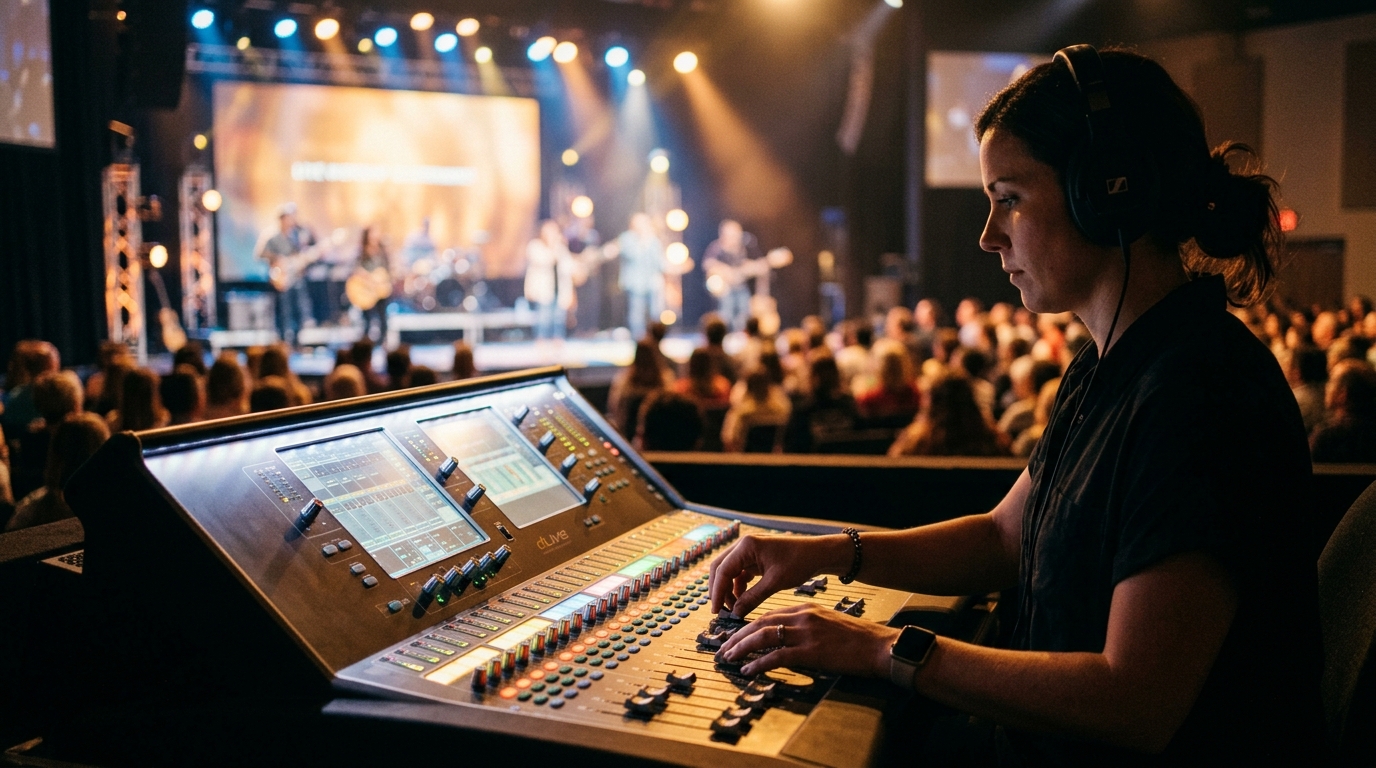
Podcasts, livestreamed worship services, touring acts, and 24-hour broadcast news all rely on someone quietly running the board — and that person is more likely than ever to have never set foot in an audio engineering classroom.
That's not a knock on formal training. Plenty of working engineers have a certificate or a degree they rarely mention. It just means the real gatekeeper for how to become an audio engineer isn't a diploma — it's your ears, your gear knowledge, and whether someone hands you a fader before you're technically "qualified" to touch one.
Here's what the job actually looks like across its three main lanes — live sound, broadcast, and church/venue AV — what training routes get you there, what the U.S. Bureau of Labor Statistics says the pay actually is, and what people already doing the work say about the trade-offs nobody puts in a course brochure.
What does an audio engineer actually do?
At its simplest: an audio engineer captures, mixes, or manages sound so it's clean, balanced, and audible to whoever's supposed to hear it. That single sentence covers a wide range of very different jobs.
- Live sound / touring — mixing front-of-house or monitors for concerts, festivals and corporate events, often on the road.
- Broadcast — running audio for live TV, radio, podcasts or streamed news, usually from a fixed control room.
- Church / venue AV — handling sound (plus often video and lighting) for a single house of worship, theater or arena, week after week.
- Studio / post-production — recording, mixing or mastering music, film or podcast audio after the fact.
Each lane has a different entry point, a different schedule and — as you'll see below — a different pay ceiling. Picking one early tends to matter more than picking a school.
How do you actually become an audio engineer without a degree?
You don't need one — and this is where a lot of career-advice pages quietly assume you're headed to a four-year program when you don't have to be. There are two real routes in, and plenty of working engineers have taken each.
The school route. Certificate programs (a few months to a year), associate degrees (about two years) and bachelor's degrees (four years) in audio engineering, music production or sound design exist at schools like Full Sail, SAE and dozens of community colleges. They buy you structured gear time, a portfolio and — often the real value — an internship placement you'd otherwise have to hustle for yourself.
The no-degree route. Start as a studio runner, assist a local sound company, volunteer on a church tech team or just start mixing bands in a bar for free. On a long-running Gearspace career thread, posters largely agree that most engineers "doing okay or well" in the field didn't go to school for it — they built a reel and a reputation instead. Threads on breaking in without formal training line up with that: a degree can open doors at certain studios, but for freelance and live work, your last few credits matter less than your last few gigs.
| Training route | Typical length | What it buys you | Best fit |
|---|---|---|---|
| Certificate program | 3–12 months | Gear fundamentals, portfolio, sometimes an internship | Fastest structured start |
| Associate degree | ~2 years | Broader technical and business basics | Broadcast/AV-leaning roles |
| Bachelor's degree | 4 years | Deepest theory, strongest alumni network | Studio, post-production, corporate track |
| No-degree / on-the-job | 1–3 years to paid work | Real credits, real gear time, no tuition | Live sound, church AV, freelance |
There's a real trade worth naming here: one Gearspace thread specifically debates whether "sound engineer" should be a formal apprenticeship, because right now the no-degree path only works if you can find someone willing to train you informally. If you can't find that person locally, a program that hands you a placement can be worth the tuition.
Live sound, broadcast or church AV — which path fits you?
This is the split most "how to become an audio engineer" guides skip, and it's the one that actually shapes your day-to-day life.
Live sound and touring pays well at the top and burns people out in the middle. Nathan Lively, a longtime live-sound industry commentator, put it bluntly: touring engineers are "probably the first generation... that have had to think about having another career," because "to earn a decent living you need to be out of the house for the whole year, to pay for the house that you're not living in." It's a real career — just not always a sustainable one long-term without a plan to move into a fixed-location role eventually.
Broadcast is the steadiest of the three. You're usually in one building, on a schedule, working radio, TV or podcast production. Pay tends to sit a notch above live and church work, more on that below, but you trade the travel for structure.
Church and venue AV is the fastest-growing on-ramp for people switching in from another field. Most houses of worship start technical staff as unpaid volunteers, then promote the reliable ones into the first paid seat — a pattern one Gearspace thread on switching careers into live sound confirms is common, noting that house-of-worship work is a growing area that increasingly blends audio with video and lighting duties. If you want in without quitting a day job first, this is usually the door.
Whichever lane you're aiming for, it helps to see what's actually open right now rather than guess: JobSnag's live audio engineer and sound production job listings span all three — touring and live-event gigs, broadcast and church AV roles, arenas and houses of worship — with real pay ranges attached to real postings.
What does an audio engineer actually get paid?
Skip the inflated "average salary" figures some career sites quote. Several of the top search results for this exact question cite self-reported salary-aggregator averages north of $80,000 with no clear methodology behind them. Here's what the government's own wage survey says instead.
The Bureau of Labor Statistics' Occupational Outlook Handbook tracks this work under "Broadcast, Sound, and Video Technicians" — 146,100 jobs nationally, a median annual wage of $56,600 ($27.21/hour) as of May 2024, and about 11,100 openings projected per year through 2034. Growth is slow at just 1%, but turnover keeps the door open.
Narrow it to the closest single occupation code, Sound Engineering Technicians (SOC 27-4014), and BLS puts national employment at 12,890 with a median annual wage of $66,430. Pay swings hard by industry:
| Setting | Mean annual pay (BLS OEWS) |
|---|---|
| Motion picture & video production | $99,990 |
| Radio & TV broadcasting stations | $59,590 |
| Sound recording industries | $59,040 |
| Promoters of performing arts/events | $57,300 |
Corporate and event AV work, the broader category that overlaps with church and venue AV, tends to land in the $50,000–$95,000 range according to AVIXA, the AV industry's own trade association, with steadier hours than touring but a similar entry bar.
How do you actually break in?
The fastest path looks less like a curriculum and more like a job search.
- Build a reel before you build a résumé. Mix a friend's band, run sound for a local open mic or volunteer at a church tech booth. You need three or four examples of work you actually did, not a list of software you've opened.
- Say yes to the boring gigs first. Cabling, patching and setup are how you get trusted with the actual mix.
- Pick a lane early, even loosely. Broadcast, live and church AV hire differently enough that "I'll do anything audio" reads as unfocused past the first year or two.
- Apply to what's actually open. JobSnag's audio, AV and live production job board lists current openings across touring, broadcast and house-of-worship production — a faster read on real requirements and real pay than any guide, including this one.
The bottom line
There's no single accepted route into this career, and that's mostly good news: it means the barrier to entry is lower than it looks from the outside, provided you're willing to start with unglamorous work and let a portfolio do the talking a diploma can't. Pick a lane, get your hands on a board, and let the work speak for itself.
Line Cook — Houston, TX
Frequently asked questions
Do you need a college degree to become an audio engineer?
No. Many working audio engineers are self-taught or trained through short certificate programs, studio runner roles, or live-sound gigs. A degree can help for certain studio or broadcast jobs, but it is not a hard requirement in most of the field.
How long does it take to become an audio engineer?
A no-degree path through internships and small gigs can take one to three years of hands-on work to reach paid entry-level roles. Certificate programs run a few months to a year, while associate or bachelor's degrees take two to four years.
What is the average pay for an audio engineer?
According to the Bureau of Labor Statistics, sound engineering technicians earned a median annual wage of about $66,430 in May 2024, though pay varies significantly by setting, from touring and church AV work to broadcast and post-production.
Is live sound engineering a stable career?
It can be, but touring work in particular is demanding and often requires long stretches away from home. Many engineers eventually move into steadier settings like broadcast, corporate AV, or house-of-worship production for better work-life balance.
What is the difference between live sound, broadcast, and church AV jobs?
Live sound and touring engineers mix sound for concerts and events, often on the road. Broadcast engineers work on radio, TV, or podcast production on a more fixed schedule. Church and venue AV roles blend audio with video and lighting for a single organization, often starting as a paid or volunteer weekend position.